Welcome to the TopShow!Garment manufacturing !
OEM, ODM Service,Custom color Custom logo,Custom Your Own Brand Online!

Finding where to buy a Color Block Stripe Dress wholesale takes more than comparing prices. Buyers need to check fabric, construction, minimum order quantities, and delivery schedules. The McKinsey and Business of Fashion State of Fashion 2024 report projected global fashion sales growth of 2 to 4 percent that year. That broad forecast offers useful context, but it does not prove demand for this specific dress style. Verify the opportunity with your own customer data.
Start by comparing manufacturers, established wholesale marketplaces, and local apparel distributors. Request a sample before placing a bulk order. Inspect stripe alignment at the seams, color consistency, fabric weight, and stitching. Ask for a written size chart and confirm whether the quoted price includes packaging and shipping. Small details matter.
A sample can look perfect under bright showroom lights. Check it in daylight, too. I would not treat one attractive sample as proof of consistent production; that assumption deserves a second look. Ask suppliers how they handle quality checks and what happens when delivered goods differ from approved specifications. Verify any claimed certifications directly with the issuing organization. This guide will help buyers assess sourcing options, compare supplier terms, and choose a Color Block Stripe Dress that fits their market, budget, and quality expectations.
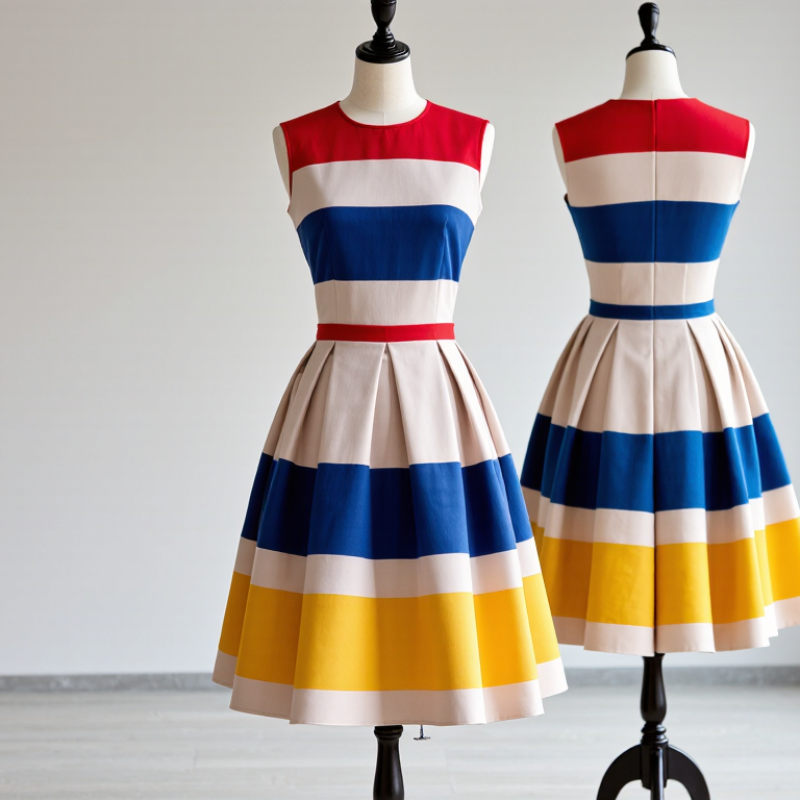
For color block stripe dresses, direct manufacturers suit buyers who need custom panel placement, stripe widths, or fabric weights. Request a size set, fabric swatches, and a pre-production sample. Check whether stripes align at side seams; small mismatches become obvious on bold color blocks. Confirm minimum order quantities, repeat-order capacity, and production timelines in writing. A low sample price alone tells you little.
Showrooms let you inspect stitching, drape, and color under real lighting before placing an order. Ask whether displayed pieces are stock samples or can be reordered. B2B marketplaces help compare suppliers, prices, and stated credentials, but listings are not quality guarantees. McKinsey’s 2024 B2B Pulse surveyed more than 3,500 decision-makers across 11 countries; 71% said they would spend over $50,000 through remote or self-service channels. Digital buying is established. Still, verify supplier documents and sample quality independently.
Tips: Send a simple tech pack showing stripe direction, color references, and measurements. Ask for close-up photos of seams and labels. Keep one approved sample as your benchmark. I would not skip this step, even when the deadline feels tight.

When sourcing color block stripe dresses wholesale, compare quotes against one shared specification: fabric composition, stripe width, color placement, size range, stitching, labels, and packaging. Otherwise, a lower unit price may simply exclude details another supplier has included. Ask each factory for its MOQ per style and per color, plus price breaks at higher quantities. Small nuance: a 300-piece MOQ may apply to one color, not the full order.
The State of Fashion 2024 report by McKinsey & Company and The Business of Fashion forecast 2–4% growth for the global fashion industry in 2024. In a cautious market, test landed cost—not just the quoted garment price. Request separate figures for samples, shipping, and any setup charges. Then compare the unit price at your likely order quantity. A low quote can still mislead.
Lead times need the same scrutiny. Ask suppliers to state sample approval time, fabric procurement time, production days, and dispatch date separately. Confirm when the clock starts: deposit, fabric approval, or final sample sign-off. For striped dresses, request photos of a finished sample; stripe matching at side seams can add production checks. Build a buffer for revisions. It is easy to underestimate those. Record each supplier’s MOQ, unit price, and quoted days in one sheet, and note which dates are estimates rather than commitments.
Where to Buy Color Block Stripe Dresses Wholesale?
Check Colorfastness with AATCC TM8 Crocking-Test Criteria
Before approving a wholesale order, ask for crocking-test results for each major color, not just one dress panel. AATCC TM8 assesses color transfer caused by rubbing, using dry and wet testing. The transferred color is rated on a gray scale from 1 to 5; higher scores indicate less staining. Small but important: TM8 describes a test method, not one universal pass mark. Agree on acceptable scores with your supplier before production.
On a color-block stripe dress, test the darkest stripe, the lightest panel, and any contrasting trim separately. A pale cotton test cloth can reveal dye transfer that is easy to miss under warehouse lighting. Wet crocking deserves attention too. Perspiration or damp handling may increase transfer, though the test itself does not reproduce every wearing condition. Ask for the test date, fabric lot, conditioning details, and dry and wet ratings. A report without these details is hard to compare.
Textile Exchange’s Materials Market Report 2024 estimates that global fiber production reached 124 million tonnes in 2023, showing the scale of material sourcing behind apparel. That figure does not predict garment colorfastness. It does make lot-level checks worthwhile: identical-looking fabric can behave differently across batches. A practical lesson is to request a production-lot sample before bulk approval. Even then, sampling has limits. Keep the report with the purchase record, and recheck if the fabric, dye lot, or finishing changes.
| Buying or Testing Dimension | What to Check | Practical Wholesale Guidance |
|---|---|---|
| Where to source | Apparel manufacturers, garment wholesalers, and verified B2B sourcing platforms may offer color block stripe dresses in bulk. | Request the seller’s business details, product specifications, sample policy, production location, and written quality-control terms before placing an order. |
| Color-block construction | Check stripe alignment, panel placement, seam quality, and shade consistency between panels and garments. | Approve a pre-production sample and specify acceptable color variation and stripe-placement tolerances in the purchase agreement. |
| AATCC TM8 purpose | AATCC TM8 evaluates color transfer from a textile surface to a white crocking cloth through rubbing. | Ask for a test report identifying the tested colorway, fabric, test date, method edition, and whether the result is for dry or wet rubbing. |
| Dry crocking | The specimen is rubbed with a dry crocking cloth, and staining on the cloth is evaluated. | Request dry-rubbing results for each distinct dark or saturated color used in the dress, not only for a light-colored panel. |
| Wet crocking | The procedure uses a water-moistened crocking cloth; the report should identify the wet-test result separately from the dry result. | Give wet-rubbing performance particular attention for garments likely to encounter perspiration, rain, or damp storage. |
| Staining assessment | Color transfer is commonly rated with the Gray Scale for Staining, from 1 (heavy staining) to 5 (negligible or no staining); intermediate ratings may also be reported. | Set the required minimum rating in the order specification. AATCC TM8 itself does not establish one universal pass/fail grade for every garment or end use. |
| Test sampling | Results apply to the submitted specimen and tested conditions; different fabrics, dye lots, and colorways can perform differently. | Test representative production fabric or finished-garment panels from each colorway and repeat checks when the material or dye lot changes. |
| Wholesale order terms | Minimum order quantity, size assortment, lead time, sample charges, and return or defect terms vary by seller and product. | Confirm these terms in writing and compare the landed cost, including shipping, duties where applicable, inspection, and any testing fees. |
| Buyer acceptance specification | A purchase specification can define required dry and wet crocking grades, tested colorways, sample approval, and corrective-action requirements. | Treat any chosen grade as a buyer-defined requirement, not as a universal AATCC TM8 acceptance limit. |
Wholesale buyers looking for color block stripe dresses should assess the sewing facility, not just the sample rack. Ask which factory will cut, sew, and finish the garments; subcontracting can change after sampling. That detail matters. WRAP certification applies to a specific facility and period, so check the factory name, address, scope, and expiry date. Do not treat a certificate image as proof by itself.
Request current documentation and confirm its status through WRAP’s official verification channels or direct written confirmation. Compare the certified site with the address on the purchase order and production records. Look for practical evidence too: worker age records, safe exits, clean rest areas, working-hour logs, and a clear grievance process. Ask to review records from the actual production floor, not just a polished presentation. Small mismatch? Pause.
For striped dresses, inspect a production sample for stripe alignment at side seams, even color-block edges, and consistent grading across sizes. These checks do not prove ethical practice, but they help connect factory controls with the order you plan to place. Keep audit dates, corrective-action notes, and approved factory details in writing. Factories can improve, and paperwork can lag. That is worth questioning.
Wholesale quotes for color-block stripe dresses rarely show the true landed cost. Price each sellable dress after freight, insurance, duties, brokerage, and destination fees. UNCTAD’s Review of Maritime Transport 2024 reports that shipping carries over 80% of global trade by volume. Freight changes can therefore shift unit economics quickly. Get a dated quote based on carton dimensions, gross weight, shipment mode, and destination. A small carton-volume error matters.
For a practical check, imagine 500 dresses priced at $8 each, with $1,200 for freight and insurance. If the applicable duty were 12% of an illustrative $5,200 customs value, duty would add $624. Add, for example, $350 in handling and brokerage: the estimated landed cost becomes $6,174, or about $12.35 per dress. This is only a planning example. Customs valuation rules and duty rates vary by destination, origin, fabric, and garment construction.
Before placing an order, verify the product classification and current rate in the destination’s official tariff database, such as the USITC Harmonized Tariff Schedule or the EU TARIC database. Check whether the dresses are knit or woven and confirm their fiber content with the supplier. Keep VAT or other recoverable import taxes separate from the product-cost estimate. I still allow a contingency; port charges and inspection delays can make a tidy spreadsheet look optimistic.