Welcome to the TopShow!Garment manufacturing !
OEM, ODM Service,Custom color Custom logo,Custom Your Own Brand Online!

China has become a major sourcing base for outerwear, including the increasingly versatile Long Trench Coat. The World Trade Organization’s World Trade Statistical Review 2024 identifies China as the world’s leading exporter of clothing. This position reflects deep fabric networks, skilled sewing labor, and large-scale production capacity.
Market conditions still require careful judgment. The State of Fashion 2025, published by The Business of Fashion and McKinsey, describes fashion growth as cautious and uneven. Buyers therefore need more than a competitive factory price. They must assess material consistency, production flexibility, lead times, and quality controls. A well-made trench coat should hang cleanly at the shoulders, close smoothly, and maintain shape after repeated wear. Small details matter.
Reliable Chinese manufacturers may support cotton gabardine, recycled polyester, wool blends, water-resistant finishes, and private-label development. However, capabilities vary widely. Some factories specialize in mass production, while others handle smaller collections with detailed sampling. Buyers should review factory experience, certifications, testing records, social-compliance procedures, and export references. Independent inspections can verify measurements, stitching density, colorfastness, and packaging before shipment.
No supplier list is perfect. That deserves attention. Report figures also differ by product definition and reporting period. A practical sourcing decision should combine published industry evidence with current factory verification. This guide introduces China’s leading Long Trench Coat manufacturers for global buyers, focusing on production strengths, customization options, minimum order quantities, communication standards, and quality reliability. The goal is not simply to find the lowest quote. It is to identify a dependable partner for durable, commercially suitable outerwear.
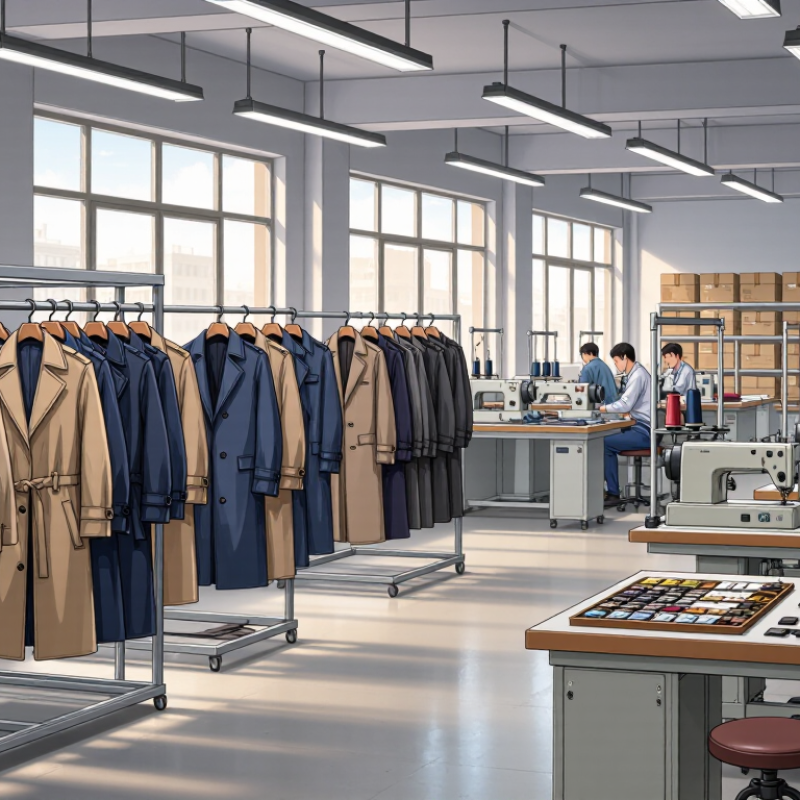
A top long trench coat manufacturer combines technical skill with dependable production control. In practical sourcing work, the first evidence appears in the sample room. Clean lapel edges, balanced shoulders, smooth lining, and even topstitching show whether a factory understands structure. Details matter.
Reliable manufacturers explain fabric composition, shrinkage results, colorfastness testing, and available weight ranges. They should also provide clear measurement charts and explain how pattern adjustments affect movement. A long coat must hang correctly without restricting the wearer. Small defects multiply across large orders.
Production transparency is equally important. Strong suppliers document fabric inspections, cutting checks, sewing inspections, and final measurements. They can discuss lead times honestly, including delays caused by fabric shortages or rework. Some factories promise too much during early negotiations. That deserves caution.
A capable manufacturer also supports low-volume sampling before bulk production. This process helps buyers review buttons, belt length, sleeve pitch, and hem balance. Digital communication is useful, but physical samples reveal issues that photographs miss. No factory is perfect. The better question is whether its team records mistakes, corrects them, and prevents repetition. Consistent communication, responsible material sourcing, and respect for applicable product and labor requirements further distinguish a serious manufacturing partner.

China’s long trench coat production is concentrated in several practical manufacturing regions. Jiangsu and Zhejiang offer strong pattern development, fabric sourcing, and mature sewing lines. Their factories commonly handle wool blends, cotton twill, polyester, and recycled technical fabrics. These areas suit buyers seeking stable quality and medium-to-large production runs.
Guangdong provides flexible development and faster response for fashion-focused collections. Manufacturers there often support digital sampling, small-batch orders, and detailed hardware customization. Fujian and nearby coastal regions are experienced in lightweight outerwear and water-resistant construction. Typical capabilities include taped seams, inner linings, detachable belts, storm flaps, and adjustable cuffs.
Production quality varies by factory. That matters. A capable supplier should provide fabric test reports, measurement charts, pre-production samples, and inspection records. Experienced buyers usually check shrinkage, colorfastness, seam strength, and button security before bulk production. Factory visits can reveal practical details, such as cutting-room cleanliness and storage conditions. However, a polished showroom does not guarantee consistent output. I have found that sample approval alone can create false confidence, especially when bulk fabric differs slightly from the approved swatch. Clear specifications, staged inspections, and documented corrections reduce this risk. Some factories still rely heavily on manual finishing, which may improve character but affect uniformity. Careful communication is essential when ordering long coats for different climates and retail requirements.
For global buyers, a long trench coat starts with measurable material choices. Textile Exchange’s Materials Market Report 2024 recorded global fiber production at about 124 million tonnes in 2023. Polyester remained the dominant fiber, while recycled inputs continued gaining attention. Buyers should request fiber composition, recycled-content evidence, and colorfastness results. A tightly woven cotton blend offers structure, but it may crease faster in humid climates. Recycled polyester improves consistency, though it can feel less breathable. That trade-off matters.
Construction quality appears in small details. Specify fabric weight, seam allowance, stitch density, and reinforcement at pocket corners. A practical specification may require taped or clean-finished seams, bartack reinforcement, and a two-way metal zipper. Testing can reference ISO 12947 for abrasion resistance, ISO 105 for colorfastness, and ISO 13934-1 for tensile strength. These standards do not guarantee a perfect coat. They create comparable evidence. Some suppliers still provide attractive samples with weak lining attachment. Inspect the second production piece, not only the first sample.
Customization should cover sleeve length, storm flaps, lining, buttons, labels, and packaging. For bulk orders, request a graded size set and a pre-shipment inspection. The International Trade Centre emphasizes accurate product specifications in global sourcing, and trench coats need unusually precise measurements. A three-centimeter shoulder error can change the silhouette. It happens. Buyers should also confirm restricted-substance testing and care-label accuracy before approval. Specification sheets are useful, but physical inspection remains essential.
Typical shell-fabric weight bands for long trench coats, supporting material selection, construction planning, and customization decisions.
The chart shows commonly specified commercial fabric-weight ranges in grams per square meter (g/m²). Lighter polyester microfiber is suitable for packable transitional coats, while heavier wool blends provide greater warmth and structure. Buyers should confirm water repellency using ISO 4920 or AATCC 22, colorfastness using ISO 105 methods, and final construction details such as seam type, lining, interlining, hardware, and size grading during product development.
Global buyers evaluating Chinese trench coat suppliers should begin with evidence, not polished catalogues. The WTO World Trade Statistical Review 2023 shows China supplied about one-third of global clothing exports in 2022. Scale is useful, but it does not guarantee stable workmanship. Request factory photos, production records, test reports, and recent shipment references. Check whether the supplier owns production lines or subcontracts critical operations. This distinction matters.
A practical audit should examine fabric weight, shrinkage, seam strength, button attachment, lining alignment, and waterproof performance. Textile Exchange’s Materials Market Report 2024 estimates global fibre production reached 124 million tonnes in 2023, with polyester representing roughly 57%. Therefore, ask for fibre composition and origin documents, especially when recycled content is claimed. Certificates should match the actual fabric batch. A certificate alone is not enough.
Evaluate samples under realistic conditions. Wear the coat, inspect it after pressing, and measure it again after washing. Small defects often appear later. I have seen attractive samples hide weak sleeve seams. The supplier should explain tolerances in writing. Compare pre-production and final samples, then retain an approved reference piece. The World Bank’s Logistics Performance Index 2023 placed China 19th globally, indicating strong logistics capacity, but delivery still depends on port planning, packaging, and communication. Track these details with a supplier scorecard. Perfect evaluation is impossible. Careful buyers still revise their checklist.
| Evaluation Dimension | Why It Matters | Practical Benchmark for Global Buyers | Documents or Evidence to Request | Suggested Weight |
|---|---|---|---|---|
| Manufacturer Experience | Relevant experience reduces pattern, construction, and production risks for long trench coats. | At least 3 years of documented experience producing woven outerwear or trench coats for export markets. | Factory profile, production photos, anonymized order records, export history, and product development examples. | 10% |
| Fabric and Material Capability | Fabric weight, fiber composition, handle, colorfastness, and water resistance directly affect garment performance. | Can provide multiple shell-fabric options, verified fiber content, GSM information, and testing support before bulk production. | Fabric swatches, technical data sheets, fiber-composition reports, colorfastness results, and water-repellency test reports where applicable. | 15% |
| Pattern and Sample Development | Long coats require accurate balance, sleeve alignment, collar shape, lining control, and size grading. | Able to complete a first sample, fit revision, size set, and pre-production sample with written measurement control. | Measurement chart, graded size specification, sample review form, fit comments, and approved pre-production sample. | 15% |
| Minimum Order Quantity | MOQ affects inventory exposure, launch flexibility, color selection, and cash-flow planning. | Confirm MOQ separately by style, color, and fabric; many export factories quote different limits for stock and custom materials. | Written MOQ quotation, color-breakdown rules, surcharge schedule, and fabric minimums from nominated mills. | 10% |
| Production Capacity and Lead Time | Reliable capacity is essential for seasonal launches and replenishment programs. | Request capacity by month and season; a typical export order may require approximately 45–90 days after approval, depending on fabric availability and order complexity. | Capacity plan, production calendar, critical-path timeline, fabric booking confirmation, and shipment-performance history. | 15% |
| Quality Management | Consistent sewing, pressing, measurements, and finishing protect returns and customer satisfaction. | Uses written quality standards, inline inspection, final inspection, measurement tolerance control, and corrective-action procedures. | Quality manual, inspection checklist, measurement tolerance chart, defect classification, and recent third-party inspection reports. | 15% |
| Compliance and Social Responsibility | Retail and marketplace buyers may require product safety, restricted-substance, labor, and environmental documentation. | Can support applicable requirements such as REACH-related material controls, restricted-substance testing, and buyer-specific social audits. | Test reports, audit reports, chemical-management procedures, material declarations, and factory business licenses. | 10% |
| Customization and Private Label Support | Brand-specific labels, trims, packaging, hardware, and construction details require coordinated development. | Supports custom labels, care labels, hangtags, packaging, buttons, buckles, embroidery, and approved tech-pack execution. | Customization checklist, trim approval sheet, packaging specification, artwork confirmation, and sample photos. | 10% |
| Pricing and Total Landed Cost | The lowest unit price may be offset by sampling, tooling, inspection, freight, duties, or rework costs. | Compare quotations using the same fabric, trims, packaging, Incoterm, payment terms, and inspection scope. | Detailed quotation, cost breakdown, sample charges, tooling fees, payment schedule, Incoterm, and freight assumptions. | 5% |
| Communication and Order Transparency | Fast, documented communication helps prevent specification errors and delays across time zones. | Provides a clear contact person, responds within one or two business days, and confirms changes in writing. | Sample communication log, order calendar, production updates, escalation process, and written approval workflow. | 5% |
| Total Evaluation Weight | 100% | |||
For global buyers, China’s top long trench coat manufacturers must offer more than competitive factory pricing. Export service begins with clear Incoterms, carton specifications, and customs-ready documents. The WTO’s World Trade Statistical Review 2024 reported a 1.2% decline in world merchandise trade volume during 2023. That pressure makes shipment accuracy important. A missed sailing can damage seasonal sales.
Reliable quality control should cover fabric weight, water resistance, seam strength, and lining alignment. Inspectors can check pilot samples before bulk cutting, then review production at fixed checkpoints. For long coats, sleeve length and hem balance need special attention. A two-centimeter error can change the garment’s appearance. AQL-based inspections help create measurable acceptance rules, but buyers should not treat them as perfection. No factory is flawless.
Strong order management connects sampling, purchasing, production, and export teams in one record. Buyers should receive dated approvals, material updates, packing photos, and pre-shipment inspection results. The UNCTAD Handbook of Statistics shows China remains the world’s largest merchandise exporter by value, supporting its broad logistics capacity. Capacity alone is not enough. Experienced suppliers should explain delays early and document corrective action. That honesty is useful. Small misses compound. A shared order tracker, bilingual specifications, and a named export contact can reduce avoidable disputes.