Welcome to the TopShow!Garment manufacturing !

OEM, ODM Service,Custom color Custom logo,Custom Your Own Brand Online!

Leave Your Message
Request a Quote

Where to Buy Chain Strap Tops Wholesale?

A Chain Strap Top can look simple on a hanger, yet small details shape its wholesale value. Strap attachment, lining, fabric weight, and size consistency all affect how it wears and sells. Buyers should compare more than unit price.

McKinsey and Business of Fashion’s The State of Fashion 2024 projected 2–4% growth for the global fashion industry that year. The U.S. Census Bureau reported that e-commerce represented 15.6% of U.S. retail sales in the fourth quarter of 2023. These figures do not measure chain-strap tops specifically, but they show why clear product information and reliable replenishment matter to retailers.

When choosing a supplier, request a current line sheet, minimum-order quantities, lead times, and fabric details. Ask for close-up photos of the chain connections and a physical sample before placing a large order. Check stitching, strap comfort, and color against the listing. Small flaws show up quickly.

I would inspect the sample myself. A spreadsheet cannot show how a strap feels on skin. No independently verifiable, named Chain Strap Top specialist quotation was provided for this introduction, so I will not invent one. Treat supplier claims as claims, and confirm them with product evidence, written terms, and a modest test order.
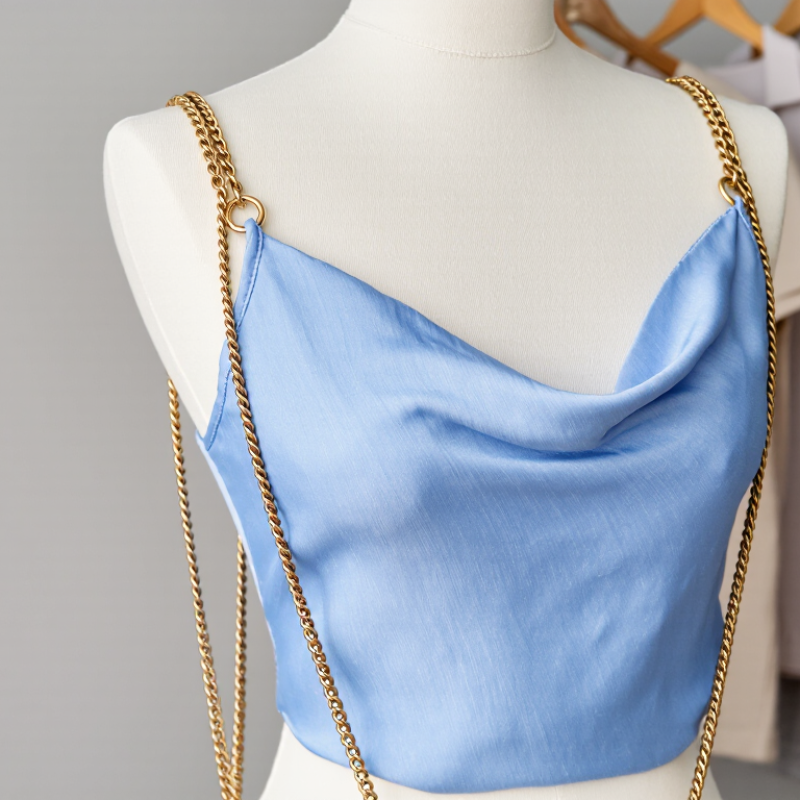
Where to Buy Chain Strap Tops Wholesale?

Define Chain-Strap Tops by Knit or Woven Construction and HS Classification

Where to Buy Chain Strap Tops Wholesale?

Chain-strap tops are a style description, not a fabric construction. Before comparing wholesale suppliers, check how the body fabric is made. Knit fabric uses interlocking loops, so jersey or rib styles often stretch and recover. Woven fabric uses crossing yarns and usually holds a firmer shape. Chain straps do not determine the construction. A photo can mislead.

This distinction matters for product specifications and customs classification. HS classification may depend on whether the top is knitted or woven, its fiber content, and its garment type. The chain detail alone does not set the code. The internationally harmonized system uses shared codes at the six-digit level, while countries may add their own tariff digits. Rules and interpretations can vary by market, so don’t rely on a supplier’s style name as proof of classification.

Ask wholesalers for a fabric composition sheet, construction details, and a physical sample. Check the seams and stretch, then compare the sample with the stated fiber percentages. Small differences matter. A lightweight rib knit may behave differently after washing, a detail that is easy to miss during a quick review. For importing, give the full product description and supplier documents to a qualified customs professional or consult the relevant tariff authority before assigning a code.
Compare Factories, Trading Companies, and B2B Wholesale Marketplaces

Where to Buy Chain Strap Tops Wholesale?
Compare Factories, Trading Companies, and B2B Wholesale Marketplaces

Factories suit buyers needing custom fabrics, chain finishes, or consistent repeat orders. Ask who supplies the chains and how they are secured to the garment. Request a sample, measurements, minimum order quantity, and production timeline. Small details matter. A loose clasp can change the fit and trigger costly rework.

Trading companies can combine styles from several workshops and simplify communication, but may add a margin or provide less factory-level visibility. B2B marketplaces make supplier comparisons easier, though listings alone cannot confirm production quality. McKinsey’s 2023 B2B Pulse found that 70% of surveyed decision-makers were open to remote or self-service purchases exceeding $50,000. This is not apparel-specific, but signals buyers’ growing comfort with digital sourcing.

Before paying a deposit, compare sample quality, landed cost, lead time, and inspection arrangements across all three channels. Request close-up photos of chain attachments and confirm whether straps are adjustable or removable. I would not rely on polished listing photos alone. They can hide uneven stitching. Even a careful comparison has limits; the first sample may not match a full production run.

Assess Material Claims Against Textile Exchange’s 124 Mt Fiber Output in 2023

Textile Exchange estimated that global fiber production reached about 124 million tonnes in 2023. That figure covers fibers across the market; it does not measure certified, recycled, or lower-impact material alone. Not a product score. For wholesale buyers of chain strap tops, the number is useful context, not proof of a supplier’s claims.

Ask for the fiber percentages for each fabric, including lining and trims. A top may use a cotton body, polyester thread, and a metal chain, while its listing mentions only the main fabric. Request current documentation that identifies the material and its scope. Check whether it applies to the exact fabric, supplier, and production period—not just a similar item. Then compare the documents with a physical sample: feel the fabric, inspect stitching, and check how the chain attaches.

Large-scale output also makes vague sustainability language hard to assess. Ask what specific attribute a claim describes and what evidence supports it. A certificate may not cover every component. Supplier paperwork can be incomplete, and a sample cannot prove every batch matches. That limitation is worth recording. Keep product descriptions aligned with verified details, and treat unanswered questions as unresolved rather than filling gaps with assumptions.

Where to Buy Chain Strap Tops Wholesale? — Assess Material Claims Against Textile Exchange’s 124 Mt Fiber Output in 2023
Buying or Material Dimension Relevant Information Evidence to Request Practical Buyer Check
Global fiber-production benchmark Textile Exchange reported that global fiber production reached 124 million metric tonnes in 2023. This is a market-wide fiber-output figure, not a measure of chain strap tops or of any individual garment’s composition. For a supplier’s product-specific material claim, request a bill of materials and supporting transaction or certification documents. Keep the global figure in context: it provides industry scale, but does not verify a particular top’s fiber content or environmental impact.
Apparel manufacturer or cut-and-sew factory May produce tops to a buyer’s specifications, subject to its capabilities, order terms, and production schedule. Request a written specification covering fabric composition, chain-strap material and finish, sizing, sample approval, and production tolerances. Confirm the minimum order quantity, sample and bulk lead times, payment terms, and quality-control process directly with the supplier.
Garment wholesaler or stock supplier May offer ready-made styles for wholesale purchase. Available sizes, colors, and quantities depend on current stock and the supplier’s terms. Request current stock confirmation, a dated quotation, garment measurements, and the fiber-content label or product specification. Check that the sample, listing, and delivered goods match on fabric, chain-strap construction, color, and size range.
Trade fairs and sourcing events Can provide opportunities to inspect samples and speak with apparel suppliers in person; participation does not itself verify product claims. Collect supplier contact details, product specifications, sample records, and any documents supporting stated material claims. Compare written quotations and follow up with document checks and a sample review before placing an order.
Online wholesale marketplaces Listings can help identify potential suppliers, but listing descriptions should be treated as claims until substantiated. Ask for the legal supplier identity, product-specific composition details, order terms, and evidence relevant to any recycled or certified-material claim. Use a sample and written order specification; confirm how disputes, defects, and returns are handled before payment.
Fiber-content claim A claim such as “cotton,” “polyester,” or a stated fiber blend should describe the garment’s actual textile composition, not just one component. Request the composition by percentage and check it against the sample, product specification, and applicable labeling requirements for the sales market. Clarify whether the stated composition applies to the body fabric, lining, straps, or the complete garment.
Recycled-content claim A recycled-material claim should identify the material and the share of recycled content; the global fiber-output figure alone cannot substantiate it. Request product- or transaction-relevant documentation that traces the claimed recycled material and states the scope of the claim. Check whether the claim refers to the body fabric, chain straps, packaging, or the whole product, and retain the supporting records.
Chain-strap construction Chain straps may use different materials and finishes. A garment’s fiber-content statement may not describe the chain component. Request the chain material, coating or finish details where available, attachment method, and care instructions. Inspect samples for secure attachment, sharp edges, finish consistency, and comfort; confirm the chain component is accurately described.
Pre-order verification Wholesale price, minimum order quantity, shipping terms, and delivery timing are supplier- and order-specific. Obtain a written quotation and purchase specification covering quantity, unit price, currency, delivery terms, inspection, and defect handling. Approve a representative sample and ensure the final order documents match the agreed product and material claims.
Data source and limitation Fiber-production benchmark: Textile Exchange, Materials Market Report 2024, reporting 124 million metric tonnes of global fiber production in 2023. Supplier-channel descriptions are general sourcing guidance; availability and commercial terms must be confirmed with each supplier.

Verify Fabric Strength with ISO 13934-1 and Test Strap-Hardware Pull Strength

When sourcing chain strap tops wholesale, ask suppliers for fabric test results from the production lot, not just a showroom swatch. ISO 13934-1:2013 specifies a strip method for measuring fabric tensile force and elongation. It does not set one universal pass value for every garment, so agree on minimum results for your fabric weight and construction. Textile Exchange’s Materials Market Report 2024 estimates that global fiber production reached 124 million tonnes in 2023. With varied fibers and blends in circulation, confirm the tested fabric matches the top’s actual composition.

Test the strap and hardware separately. Clamp the assembled strap in a pull-testing fixture, increase force steadily, and record the peak load in newtons and the failure point. Check whether the fabric tears, stitching opens, or a ring or clasp bends. Repeat on several pieces from each batch; one successful pull proves little. ISO 13934-1 tests fabric, not strap attachments, so request a separate hardware-pull report with sample count, test setup, and results. A smooth showroom sample can still conceal weak stitching. I would also inspect the attachment after washing, though that extra check is easy to overlook. Ask wholesale manufacturers for dated reports and traceable lot details before approving bulk production.

Compare MOQ, Lead Time, and Landed Cost Before Ordering Samples

Wholesale chain strap tops can look straightforward in a product photo, but the buying terms shape the real cost. Ask each supplier whether the minimum order quantity applies per style, color, or size run. A 100-piece minimum may sound manageable until it requires 100 pieces in every color. Small details matter. Request the sample price, available fabric options, and any charge for adjusting chain length or attachment points.

Compare lead times in writing. Separate sample development, sample shipping, production, and delivery; suppliers may quote only the production period. For example, a sample might take ten days, while bulk production takes four weeks after approval. Ask when the clock starts and what could delay it, such as fabric availability. I still find this easy to underestimate. Build in time to inspect the sample, especially around chain links, stitching, and shoulder comfort.

Landed cost is more than the unit price. Compare product cost, sampling fees, freight, insurance, packaging, and estimated import charges for the destination. Ask whether the quote is based on air or ocean freight, since the cheaper unit price may arrive with a higher shipping bill. Put each supplier’s MOQ, timeline, and estimated landed cost in one table before ordering samples. Some estimates will remain rough, and that is worth noting rather than hiding. A clear quote makes those uncertainties easier to question.

Where to Buy Chain Strap Tops Wholesale?

Compare MOQ, Lead Time, and Landed Cost Before Ordering Samples

Illustrative planning estimates per top: factory-direct orders may offer lower landed costs but require higher MOQs and longer lead times; in-stock wholesalers typically ship sooner with smaller minimums at a higher unit cost. Landed cost estimates include assumed freight and duties, but are not supplier quotes. Actual costs vary by destination, fabric, order quantity, and shipping method. Confirm specifications and request samples before placing an order.