Welcome to the TopShow!Garment manufacturing !
OEM, ODM Service,Custom color Custom logo,Custom Your Own Brand Online!

Leave Your Message
Welcome to the TopShow!Garment manufacturing !
OEM, ODM Service,Custom color Custom logo,Custom Your Own Brand Online!
Finding reliable suppliers for a Color Block Mod Dress means looking beyond bright panels and low sample prices. Buyers need to assess fabric consistency, seam alignment, color accuracy, grading, and communication. A dress may look crisp in a product photo, yet feel stiff or pull at the shoulder when worn. Small details matter. Ask suppliers for close-up images, measurement charts, fabric descriptions, and a physical sample before discussing a larger order. One sample is not enough to judge every production run, but it can reveal careless construction early.
Color theorist Josef Albers wrote, “In visual perception a color is almost never seen as it really is—as it physically is.” That insight matters when contrasting blocks meet: lighting, fabric texture, and dye lots can shift how colors appear together. It is not a garment-sourcing verdict, but a useful reminder to check colors under consistent light and against approved references. This guide explores how to compare China-based suppliers, review their product and production capabilities, and ask practical questions about customization, quality checks, timelines, and order quantities. A polished catalogue is only a starting point. Request evidence. Compare carefully. Supplier claims can be incomplete, and even a thoughtful evaluation cannot remove every production risk.
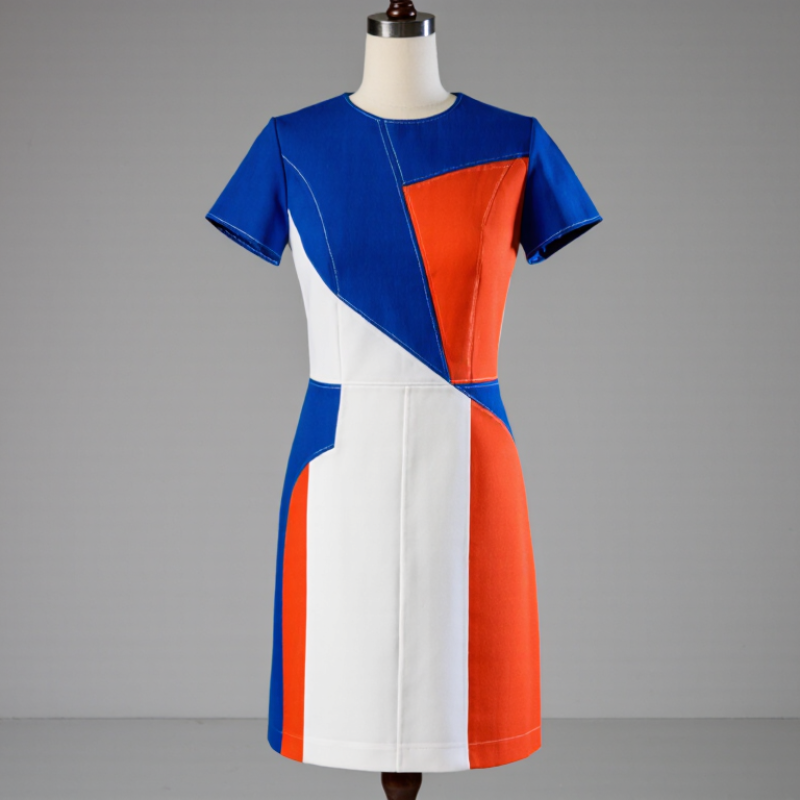
A color block mod dress pairs a clean silhouette, often A-line or shift-shaped, with clearly separated areas of contrasting color. Panels may form broad vertical strips, a strong yoke, or geometric sections across the bodice and skirt. The effect should feel deliberate, not busy. Mod styling draws on mid-century fashion, where simple shapes and bold contrast carried the look. That influence is a reference, not a rigid formula.
Construction matters as much as the palette. At each seam, adjoining panels should meet evenly, without puckering or blurred edges. Check the dress flat on a table, then in motion; a neat front can twist slightly when worn. Fabric weight also changes the result. A firm cotton blend holds an A-line shape, while a softer knit drapes closer to the body. Color can be tricky. Shades that look crisp on a screen may feel harsh in daylight, so comparing fabric swatches near a window is worthwhile. Small flaws show. A slightly uneven boundary may even alter the whole balance.
| Evaluation Area | What Defines It | What to Check When Sourcing |
|---|---|---|
| Mod-inspired silhouette | A clean, simple shape is typical of mod-inspired dresses. Common options include an A-line, shift, or straight-cut silhouette. | Request a measurement chart and sample garment. Check bust, waist, hip, shoulder, and garment length against the intended fit. |
| Color-block layout | Two or more distinct color areas are arranged as clear panels, bands, or geometric sections. Contrast and panel placement create the visual effect. | Approve a color-and-panel placement reference before production. Confirm that panels align at seams and that the color arrangement is consistent across sizes. |
| Fabric selection | Fabric should suit the silhouette and intended season. Woven options can hold a structured shape; knit options generally provide more stretch. | Ask for fiber composition, fabric weight, stretch and recovery details, and a physical swatch. Verify care instructions and any applicable test reports. |
| Color consistency | Color-block panels need coordinated shades and a controlled contrast level. Dye-lot variation can affect how panels look together. | Approve lab dips or fabric swatches under consistent lighting. Ask how bulk fabric shades are checked and documented before cutting. |
| Panel construction | Color sections may be joined as separate fabric panels or created using other garment-construction methods. Clean, balanced seams help preserve the design. | Inspect seam alignment, seam finish, stitching, and panel matching on a pre-production sample, especially at side seams and prominent horizontal joins. |
| Fit and size grading | A consistent design should retain its intended proportions across the size range; panel positions may need adjustment as garment dimensions change. | Review the size specification and grading rules. Check fit samples in more than one size when the order requires a broad size range. |
| Sampling and approvals | A sample allows the buyer to assess appearance, fit, fabric, color placement, and workmanship before bulk production. | Confirm sample stages, revision procedures, approval records, and the final reference sample that bulk production will follow. |
| Production capability | A suitable supplier should be able to explain its process for sourcing fabric, cutting multiple colors, assembling panels, and checking finished garments. | Ask for relevant product samples, production lead-time assumptions, quality-control steps, and written order terms. Verify details directly with the supplier. |
| Order terms and compliance | Minimum order quantities, pricing, lead times, and compliance requirements vary by supplier, fabric, and order specification. | Request a written quotation that states quantity, size and color breakdown, packaging, delivery terms, payment schedule, and any required testing or documentation. |
| Final quality inspection | A finished dress should match the approved specifications and be checked for visible defects, measurements, color placement, and workmanship. | Agree on inspection criteria before production. Check garments against the approved sample and specification before shipment. |